
Things To Do
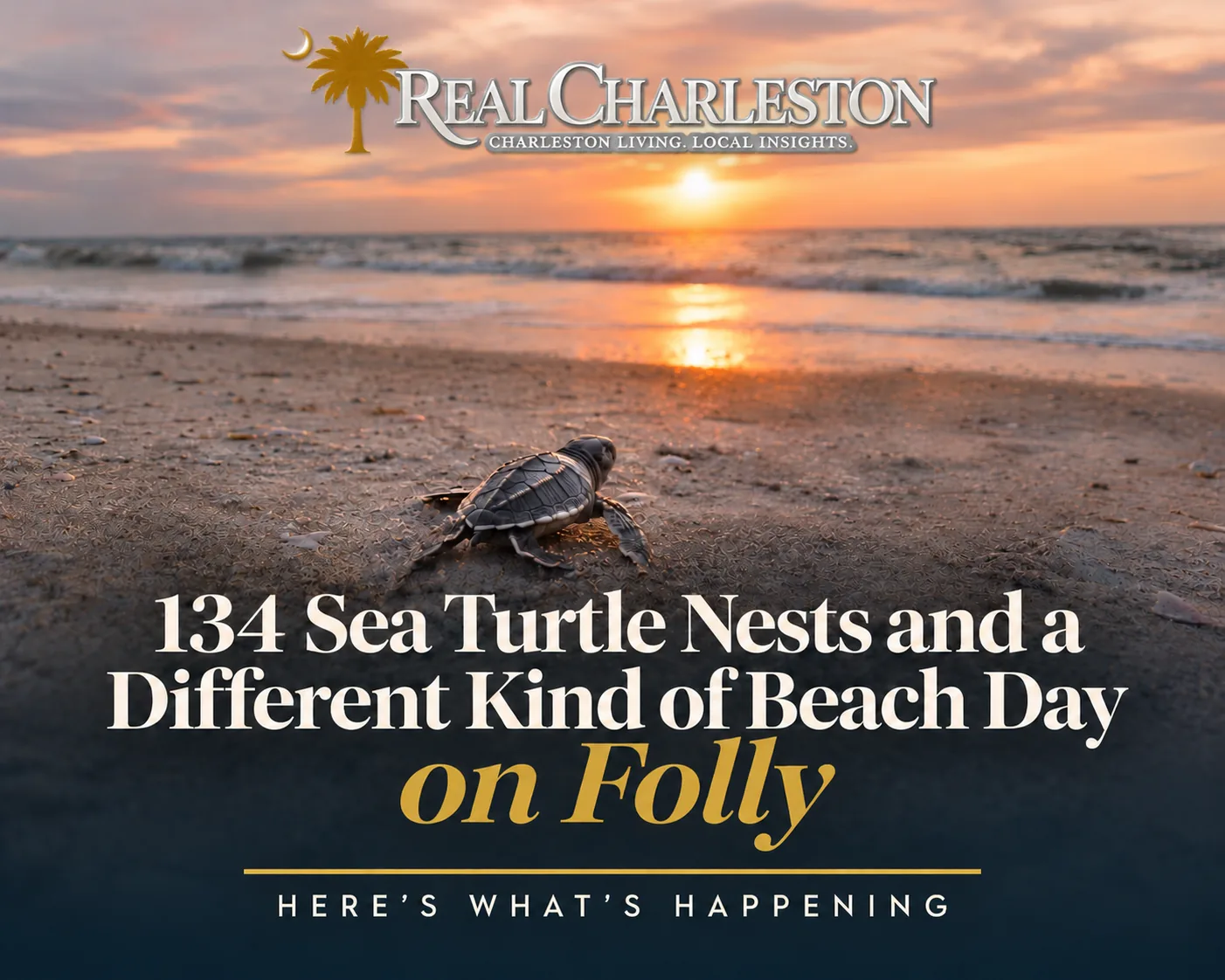
134 Sea Turtle Nests and a Different Kind of Beach Day on Folly
While the rest of us were busy finding parking, Folly Beach had thousands of tiny visitors preparing for their first trip to the Atlantic. And thanks to a dedicated group of early risers, 2026 turned into quite the year for sea turtles.
By Real Charleston |
The Beach Has a Night Shift. And Apparently, It's Pretty Busy.
A typical morning on Folly Beach involves a few familiar things: surfers checking the waves, someone walking barefoot with coffee, and at least one person discovering that free parking is basically a mythical creature.
But while most of us are still deciding whether it's worth getting out of bed, another group has already been hard at work.
They're not looking for the perfect wave or a good spot to put their beach chairs.
They're looking for turtle tracks.
And this year, they found plenty.
According to an October 20 report from Folly Beach's official visitor website, 134 sea turtle nests were recorded on the island during the 2026 nesting season as of October 8.
That's more than double the 59 nests recorded in 2025.
Apparently, word got around in the sea turtle community.
134 Nests. 10,790 Hatchlings. A Whole Lot of Tiny Flippers.
Of the 134 nests documented on Folly Beach, 133 belonged to loggerhead sea turtles, while one belonged to a green sea turtle.
But the nests themselves are only part of the story.
As of October 8, volunteers had documented 10,790 hatchlings emerging from their nests.
That's nearly 11,000 little turtles beginning one of nature's more intimidating journeys: crawling across the sand toward an ocean that's considerably bigger than they are.
No swimming lessons. No lifeguard instructions. Just instinct and a very determined set of flippers.
And while those numbers are impressive, there's an important distinction: emerging from a nest doesn't guarantee a hatchling will survive the journey or reach adulthood.
Nature doesn't hand out participation trophies.
Still, the numbers offer something worth celebrating.
Folly Beach recorded 59 nests in 2025 and 130 in 2023. With 134 documented by October 8, the island had already surpassed both years.
These are figures reported as of October 8, not necessarily the final totals for the season.
The Real MVPs Were Up Before Sunrise
Here's a number that might be even more impressive than the nest count.
More than 1,000 miles.
That's how far Folly Beach Turtle Watch volunteers walked while patrolling the shoreline over 161 consecutive mornings.
For perspective, that's an awful lot of sand in your shoes.
From May through early October, volunteers searched for signs of nesting activity, monitored nests, collected important conservation information, and helped protect one of the island's most vulnerable residents.
It's patient, repetitive work that rarely attracts the attention given to more glamorous beach activities.
There are no crowds cheering when someone identifies turtle tracks at sunrise.
No trophies for getting sand in your socks before breakfast.
And certainly no guarantee that every nest will hatch successfully.
But these volunteers keep showing up anyway.
Because protecting sea turtles isn't just about one successful season. It's about giving future generations a better chance to return to these same beaches.
And that's a pretty meaningful reason to set an early alarm.
How Not to Be the Villain in a Baby Turtle's Story
Now, before everyone rushes to Folly with a flashlight and a camera hoping to witness a tiny turtle parade, there's something worth mentioning.
Please don't.
The South Carolina Department of Natural Resources specifically discourages people from attempting to watch hatchlings emerge from their nests.
Artificial lights, crowds, and human interference can disorient or endanger young turtles during an already difficult journey.
The good news? Helping doesn't require a wildlife biology degree.
It mostly requires a little common sense.
Keep unnecessary lights off the beach during nesting season. Respect marked nesting areas. Fill in holes before leaving. Take beach chairs, umbrellas, and other belongings with you.
And if you happen to encounter hatchlings, give them space. Don't touch them, photograph them, shine lights on them, or attempt to guide them into the ocean.
They've been navigating this journey for a very long time without our assistance.
The least we can do is avoid making it harder.
A Different Reason to Love Folly
There's no shortage of reasons people love Folly Beach.
The waves. The restaurants. The fishing pier. That wonderfully laid-back atmosphere that makes you forget, at least temporarily, about whatever was stressing you out before you crossed the bridge.
But there's another side of the island that doesn't always get the same attention.
One that happens early in the morning, quietly, with a group of volunteers walking the sand and looking for signs of new life.
The 2026 nesting season is a reminder that Folly Beach isn't just somewhere we go to enjoy the ocean.
It's also part of an ecosystem that depends on us being good neighbors.
And when nearly 11,000 hatchlings emerge from the sand, it certainly puts our complaints about beach parking into perspective.
So here's a question worth asking: As more people discover and enjoy Folly Beach, how do we make sure the wildlife that calls it home still has room to thrive?
Sources
- Visit Folly Beach — 134 Nests, 1,000 Miles, and Thousands of Tiny Flippers (October 20, 2026)
- South Carolina Department of Natural Resources — Observing Sea Turtles
- South Carolina Department of Natural Resources — Sea Turtle Conservation