Art & Culture
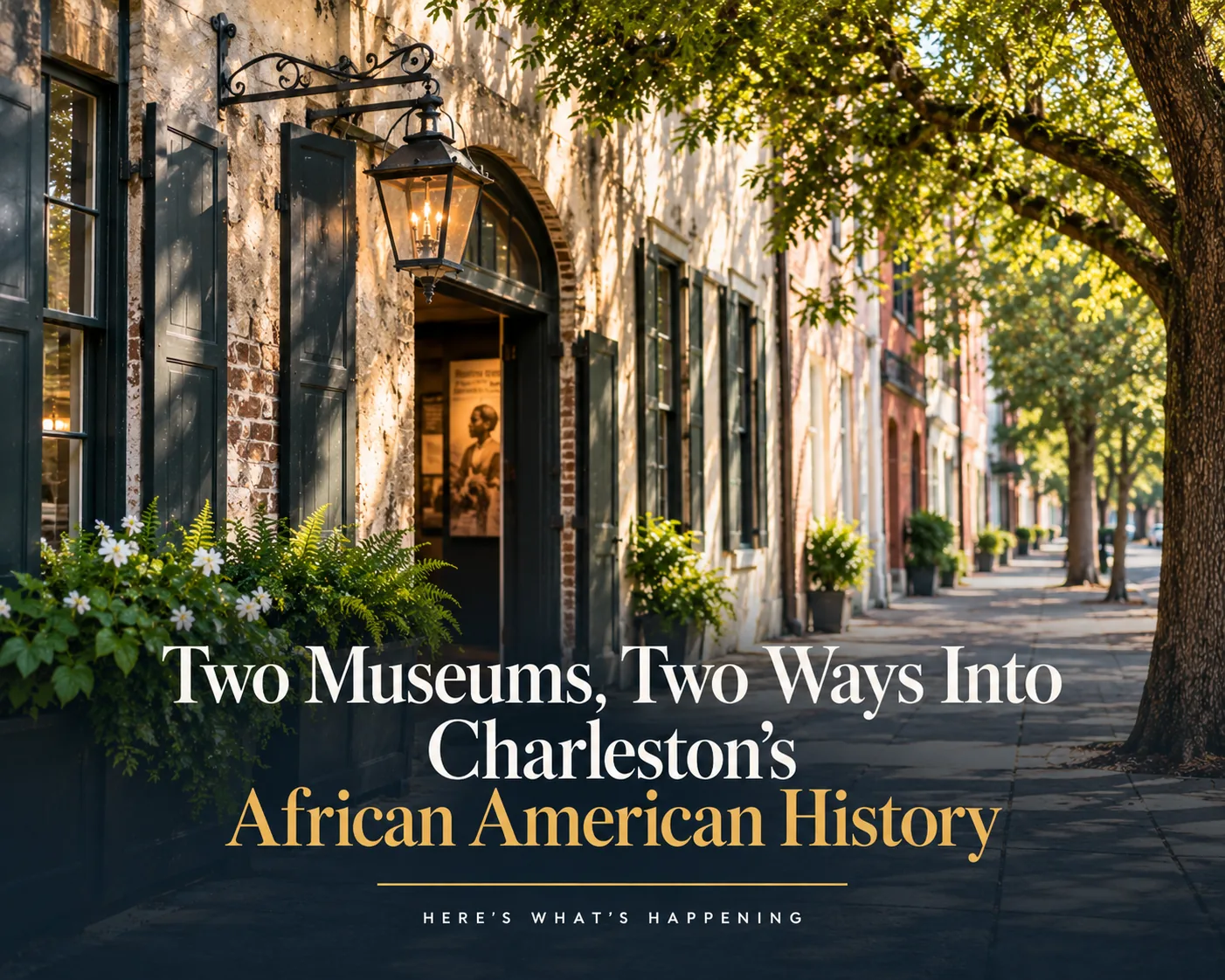
Two Museums, Two Ways Into Charleston’s African American History
Charleston has no shortage of history. But some of its most important stories require more than a walking tour and a few photographs. Two downtown museums offer very different ways to understand a past that continues to shape the city today.
By Real Charleston |
Charleston's History Goes Deeper Than Its Postcards
Charleston is remarkably good at looking like a postcard.
Pastel-colored houses, cobblestone streets, horse-drawn carriages, and enough historic architecture to keep a tour guide talking until dinner.
But behind those beautiful buildings is a history that deserves more than a passing mention.
African Americans have been central to Charleston's story for centuries. Their labor, experiences, resilience, and contributions helped shape the city we recognize today. And understanding that history means confronting some of its most painful chapters.
Two museums downtown help tell that story: the Old Slave Mart Museum and the International African American Museum.
They're not interchangeable, and they're not competing to tell the same story.
In fact, understanding what makes them different is part of what makes visiting both worthwhile.
The Old Slave Mart Museum: A History Behind the Walls
Walk down Chalmers Street today, and you'll find the kind of historic Charleston scenery that attracts visitors from around the world.
At 6 Chalmers Street, however, the Old Slave Mart Museum preserves a history that stands in stark contrast to the city's picturesque surroundings.
The museum occupies a site associated with Charleston's domestic slave trade, particularly between 1856 and 1863.
During this period, enslaved men, women, and children were bought and sold as property. The museum examines Charleston's role in that system, including the interstate trade that continued after the United States prohibited the international importation of enslaved people in 1808.
It's an important distinction.
Charleston's involvement in slavery did not end when the international trade was outlawed. The domestic trade continued, separating families and sustaining an economy built on human bondage.
The Old Slave Mart Museum brings visitors face-to-face with that specific chapter of the city's history.
And there's something particularly powerful about learning it in a place directly connected to the events being discussed.
This isn't history happening somewhere else, centuries removed from the streets outside.
It's Charleston's history, right here.
The International African American Museum: A Much Larger Story
A short distance away, along Charleston Harbor, the International African American Museum approaches history from a much broader perspective.
Located at Gadsden's Wharf, a site deeply connected to the arrival of enslaved Africans in America, the museum explores African American history and experiences across generations.
And its story reaches far beyond Charleston.
Through its galleries, exhibitions, and educational resources, the museum connects the history of the African diaspora with the experiences, achievements, struggles, and cultural contributions of African Americans.
It's a reminder that African American history cannot be defined solely by slavery, even while the institution confronts that history directly.
There's also the African Ancestors Memorial Garden, which provides space for remembrance and reflection.
And for those interested in exploring their own family connections, the museum's Center for Family History offers another avenue for historical discovery and genealogical research.
The museum brings together history, identity, memory, and the continuing influence of African American culture.
Where the Old Slave Mart Museum concentrates on a particular part of Charleston's past, the International African American Museum helps visitors see that history within a much larger human story.
Both perspectives matter.
Two Museums. Different Perspectives. One Charleston.
Here's where visiting both institutions becomes especially meaningful.
The Old Slave Mart Museum asks visitors to examine a specific system of exploitation and the role Charleston played in it.
The International African American Museum places the experiences of African Americans within a wider historical and cultural context, extending well beyond the institution of slavery.
One offers a focused examination of a particular chapter.
The other explores a story that spans generations, continents, and communities.
Neither replaces the other.
And neither can tell every part of a history this extensive.
Together, they offer an opportunity to understand Charleston beyond its architecture, restaurants, and famous waterfront views.
Because the city isn't simply a collection of historic buildings.
It's also the people who built them, the people who lived and worked around them, and the generations whose stories are not always visible from the sidewalk.
Don't Feel Like You Have to See Everything in One Afternoon
Charleston visitors have a remarkable ability to turn an entire vacation into a carefully timed schedule.
Museum at ten. Lunch at noon. Waterfront photographs at two.
There's nothing wrong with having a plan.
But these are two places worth experiencing without constantly checking the clock.
The exhibits address complex history, and some of the material can be emotionally difficult.
Give yourself enough time to read, reflect, and consider what you're learning.
You might choose to visit both museums on different days. Or you might prefer to see them during the same trip and continue the conversation afterward.
Either approach can work.
Just check each museum's current hours, admission information, and visitor resources before going. If you're interested in a specific program or family-history research service, it's worth confirming the arrangements directly with the institution.
The important thing isn't how many exhibits you manage to see.
It's what you take away from them.
Charleston Is Worth Understanding, Not Just Admiring
There's a reason people fall in love with Charleston.
It's beautiful. It's charming. It has a personality that somehow manages to be both wonderfully welcoming and stubbornly set in its ways.
But loving a place also means being willing to learn about the parts of its history that aren't comfortable.
The Old Slave Mart Museum and the International African American Museum offer different opportunities to do exactly that.
They invite visitors and locals alike to look beyond the familiar scenery and consider the people, experiences, and histories that shaped Charleston.
And perhaps that's what makes these visits so valuable.
You can walk out onto the same streets you've traveled a hundred times and see them a little differently.
Charleston has always been good at showing people its beauty. How well do we know the history behind it?
Sources & Further Reading
- City of Charleston — Old Slave Mart Museum
- International African American Museum — Visitor Information
- International African American Museum — Mission and History